- The AI Underground With CAIS
- Posts
- The Defense Legal AI Gap: Why Plaintiff Firms Are Going Agentic While Defense Lags
The Defense Legal AI Gap: Why Plaintiff Firms Are Going Agentic While Defense Lags
The plaintiff bar has become a natural area for legal AI because its incentives are on contingency, concentrated, and often volume-driven. Contingency fees reward speed, scale, and better case selection, all aspects that are exactly what AI excels at: intake triage, demand drafting, records summarization, and pattern recognition across thousands of similar claims. Data is structured, workflows repeat, and ROI is measurable in faster settlements and higher win rates. Defense-only firms, by contrast, operate on bespoke matters, billable hours, institutional clients, and risk minimization, thereby representing an environment where automation can feel like revenue compression rather than expansion. In short, plaintiff firms optimize for leverage; defense firms optimize for caution. This newsletter will make the needed case for defense-only legal AI solutions.

Ross Green
February 24, 2026
Table of Contents
Introduction:
Over the last two years, generative AI has moved from novelty to actual infrastructure (source). There are a plethora of AI options for the plaintiff bar, but very few, relatively, for the defense bar. This may sound peculiar, but just follow the money!

If one scans the legal AI landscape, you’ll notice something striking: plaintiff-side firms are flooded with purpose-built AI tools, from intake automation to demand generation platforms like Eve, while defense-only practices remain comparatively quiet territory.
That imbalance isn’t accidental.
Plaintiff firms run on contingency economics, high-volume workflows, and repeatable case patterns, making them ideal environments for automation that accelerates triage, document review, and settlement strategy. The ROI is direct and measurable: faster resolutions and stronger case selection.
Defense firms, meanwhile, operate in bespoke, risk-sensitive environments tied to billable hours and institutional client expectations, where efficiency gains can feel like revenue trade-offs. What defense firms need, in short, isn’t speed, per se, but really operational excellence from AI.

Created by Ross W. Green, MD on February 19, 2026. “The Legal Balancing Act.” Canva.com.
In the sections below:
Section 1 explains how litigation economics shaped today’s AI moment, then brings us to the present adoption reality.
Section 2 breaks down the three forces driving the defense lag (incentives, sales cycles, and where money flows).
Section 3 anchors it with current numbers.
Section 4 looks ahead to what changes in the next couple of years, and what defense firms can do now to turn AI from a threat into margin protection.
Section 1: The Backstory of why there’s a split in plaintiff vs. defense firm adoption of tech like AI
In this section, you’ll first get the historical “why” behind today’s split adoption patterns between plaintiffs and defense firms. Then we’ll zoom into the present: AI is widely used, but unevenly institutionalized, thereby creating a gap between individual experimentation and firm-grade, client-approved workflows, particularly on the defense legal side.
Section 1.1, The past: legal tech followed billing, not curiosity For most of modern legal history, the dominant “operating system” of law firms has been the billing model, not software. On the plaintiff side, contingency arrangements … read more here.  | Section 1.2, The present: AI is everywhere, but governed almost nowhere If you only read headlines, you’d think “law has adopted AI.” At the usage level, that’s increasingly true: Clio’s Legal Trends data shows 79% of legal professionals used AI in both 2024 and 2025 … read more here. 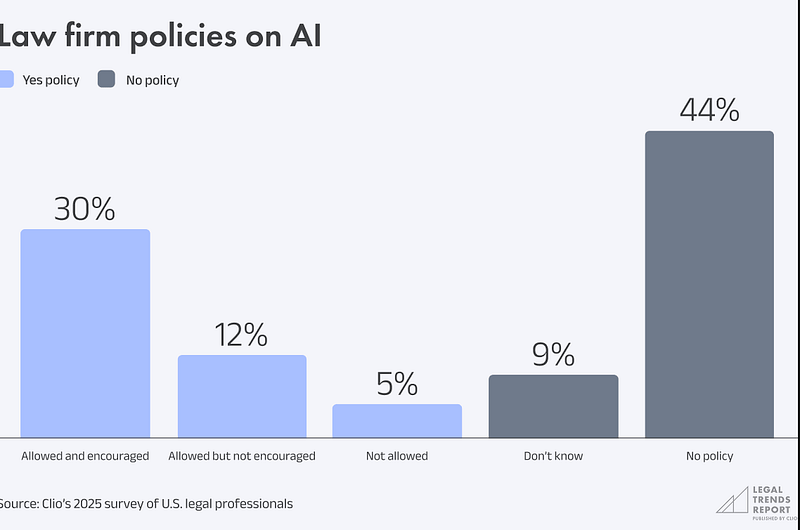 |
Section 2: Today, The three forces behind the defense lag
This section isolates the three drivers of the plaintiff/defense asymmetry.
First is incentives (what happens when efficiency threatens revenue vs. when efficiency creates revenue).
Second is the buyer journey (who must approve what, and why defense procurement is structurally slower).
Third is where money flows (plaintiff growth spend vs. defense cost-control spend), which quietly determines who builds the better AI stack.
Section 2.1, The Incentives: contingency turns speed into profit; hourly turns speed into debate Let’s verify the core claim, because it’s the cornerstone: contingency fees are a structure where the lawyer’s compensation is tied to the client’s monetary recovery rather than hourly billing, and they’re particularly common in plaintiff personal injury matters. The old “we win when you win” adage is accurate in these cases. Now compare that with defense economics … read more here.  | Section 2.2, Sales cycles: defense (realistically) doesn’t buy AI; clients and guidelines do Plaintiff firms can often decide fast. Defense firms frequently cannot, because “the customer” is an insurer, a corporate legal department, or a self-insured enterprise with legal ops infrastructure … read more here.  | Section 2.3, Where money is: plaintiff growth spend is loud; defense cost-control spend is silent If you want to predict who adopts a technology faster, follow the discretionary budget. Plaintiff-side litigation has extraordinarily visible discretionary spend: the American Tort Reform Association (or ATRA) estimates that in 2024 more than $2.5B was spent on more than 26.9M legal services ads .… read more here.  |
Section 3: By the Numbers in legal defense AI
The data shows that AI adoption across the legal ecosystem is accelerating rapidly: 79% of legal professionals report using AI, in-house GenAI usage has surged from 23% to 52% in a year, and organization-grade adoption has nearly doubled, yet governance and value capture remain uneven, with 44% of firms lacking formal AI policies and nearly 60% of clients seeing no cost savings from firms still billing ~90% of work hourly.

Created by Ross W. Green, MD on February 19, 2026. “What The Numbers Tell Us.” Canva.com.
At the same time, plaintiff-side firms are deploying capital aggressively: over $2.5B in advertising spend (with Morgan & Morgan alone at ~$218M), meaningful GenAI penetration in personal injury, and venture-backed platforms like Supio raising $60M to power plaintiff workflows. Defense-side firms, by contrast, operate within slow-moving procurement ecosystems (large vendor stacks averaging ~2,000 vendors and >$150M in spend) and suffer from revenue-ops friction (5 days to enter time, 47 to bill, 64 to collect).
The implication: plaintiffs are behaving like scaled, tech-enabled growth businesses, while defense firms remain process-heavy, hourly-driven, and operationally sluggish. If defense firms do not aggressively integrate AI into workflow, pricing, and operations, an I mean not just experimentation but structural adoption, they risk falling further behind faster, better-capitalized, AI-native plaintiff competitors.
Topic | Statistic | Source |
AI usage baseline in legal | 79% of legal professionals report using AI (2024 and 2025 in Clio’s chart) | |
AI governance gap | 44% of firms have no AI policy (plus 9% “don’t know”) | |
Organization-grade GenAI adoption | Organizations “actively using GenAI” nearly doubled: 22% (2025) vs 12% (2024) | |
In-house GenAI adoption surge | 52% of in-house counsel actively using GenAI (vs 23% in 2024) | |
Client skepticism about outside counsel savings | Nearly 60% report “no noticeable savings yet” from outside counsel using GenAI; 58% cite firms not adjusting pricing | |
Defense-side billing reality | ~90% of legal spend with law firms still flows through standard hourly rates (in that dataset) | |
Why defense procurement is slow | Large-firm vendor ecosystems average ~2,000 vendors with median spend >$150M (ex real estate) | |
Plaintiff-side discretionary growth spend | 2024 legal services advertising estimated >$2.5B across >26.9M ads | |
Concentration of plaintiff advertising power | Morgan & Morgan estimated $218M ad spend in 2024 (and ~8% of all legal services ads) | |
PI as a higher-adoption practice area | Individual GenAI use: Personal injury 37%; firm-level: PI 20% (AffiniPay survey summary) | |
Revenue ops friction inside firms | Large firms avg 5 days to enter time, 47 days to bill, 64 days to collect; 51% prioritize implementing AI/ML into processes in next 1–2 years | |
Plaintiff AI ecosystem investment | Plaintiff-focused legal AI platform Supio raised $60M Series B; positioned for PI/mass tort plaintiff work |
Section 4: The next twenty-four months
The next wave is not “more ChatGPT.” It’s agentics: systems that monitor events, route tasks, draft outputs, update systems, and escalate exceptions, all under human supervision (or under “bounded autonomy”).
In other words, AI shifting from answering to doing. This isn’t speculative since it’s already how the most operationally-minded firms are approaching automation … read more here.

Final Thoughts:
Plaintiff firms are moving faster on AI for the same reason they spend aggressively elsewhere: contingency economics reward throughput and speed, and the market is building plaintiff-specific AI products in response. Defense firms, in contrast, aren’t “behind,” but rather, they are constrained by incentives, governance, and buyer complexity.
But those constraints are exactly why defense has the biggest upside from auditable, human-in-the-loop agentic operations: fewer missed deadlines, tighter billing compliance, faster cycle time, and a clearer value story when pricing inevitably shifts away from pure hours.
It has come time for the defense to utilize the tech, but in different ways, that the opposing counsel is using daily.
Other resources:
2) Join our Community to access support from peers, a message board, and some great VIP content like our agentAcademy, weekly office hours, etc.
3) Join our weekly webinar series, "The Agentic Future with Devin Kearns" every Friday from noon-1 PM ET (11 AM-noon CT).
4) Follow us on LinkedIn: Ross Green, CAiS, Devin Kearns
5) Want to learn more about how we work (e.g., build-with-you vs. build-for-you; Prebuilt SuperAgents vs, Customized Agents; etc)? Click here to schedule a meeting with us.
6) Have a friend who wants to sign-up for our Newsletter? Click here.
7) Check out Ross Green's Medium Channel
Reply