- The AI Underground With CAIS
- Posts
- Agents at Work: Real Life Examples of How AI is Reshaping Jobs and Productivity TODAY
Agents at Work: Real Life Examples of How AI is Reshaping Jobs and Productivity TODAY
How are AI agents transforming the way we work, and what does that mean for the future of jobs, productivity, and human collaboration? This issue traces the evolution of automation from factory floors to digital offices, explores how AI is augmenting workers rather than replacing them (for now), and examines the real data behind productivity gains and ROI. Finally, it looks ahead to a near future where humans and AI co-workers share tasks, redefine roles, and force every organization to ask: is the future of work about collaboration...or competition?

Ross Green
October 14, 2025
Table of Contents
Introduction:
We’re standing at a historic crossroads in the world of work.
For over a century, technology has continuously redefined what humans do for a living, first in the factory, then in the office, and now, increasingly, through digital “co-workers” in the form of AI agents. What began as machines taking over physical labor has evolved into software capable of performing cognitive tasks once reserved for people, thereby representing an evolution that’s reshaping productivity, organizational design, and even the meaning of a “job.”
In this edition, we’ll trace that transformation from its industrial roots to its AI-driven present.
Section 1 takes a step back to show how automation’s past, including mechanical, industrial, and digital, sets the stage for this new era of intelligent agents.
Section 2 explores the key trends driving today’s workplace: how AI is augmenting rather than replacing workers, how new roles and skills are emerging, and how measurable productivity gains are already showing up in the data.
Section 3 presents a by-the-numbers snapshot of adoption, ROI, and workforce impact, while Section 4 looks forward, asking whether the future of work will be defined by collaboration between humans and AI, or competition between the two.
By the end of this newsletter, you’ll see why understanding this transition is more about adaptation, strategy, and the choices every leader and worker will face rather than just pertaining to the technology itself, as AI moves from assistant to teammate.
Section 1: Automation and Work, A Brief History
Before diving into how AI agents are reshaping modern work, it’s worth stepping back to see how we got here. The story of automation is a long one, stretching from the factory floors of the industrial age to the digital workflows of today’s offices.
In Section 1.1, “From the Factory to the Office,” we look at how past waves of automation transformed industries and labor markets, setting the stage for today’s shift from physical to cognitive automation.
Then, in Section 1.2, “The Workplace in 2025,” we examine where things stand right now, and how AI in Q4 2025 has entered the business mainstream, how adoption and results often diverge, and how companies are balancing human labor with emerging AI “co-workers.”
Together, these sections chart the throughline from the first machines that replaced manual work to the AI agents now taking on mental work, thereby helping us understand familiar patterns and new frontiers rather than simply just the pace of change.
Section 1.1: From the Factory to the Office Automation affecting the job market is far from anything new as we’ve seen waves of it for over a century. In the 20th century, machines and robots revolutionized manufacturing and agriculture, taking over repetitive manual labor and dramatically boosting efficiency (while also displacing some jobs in the process). Each time, humans adapted by…read more here. 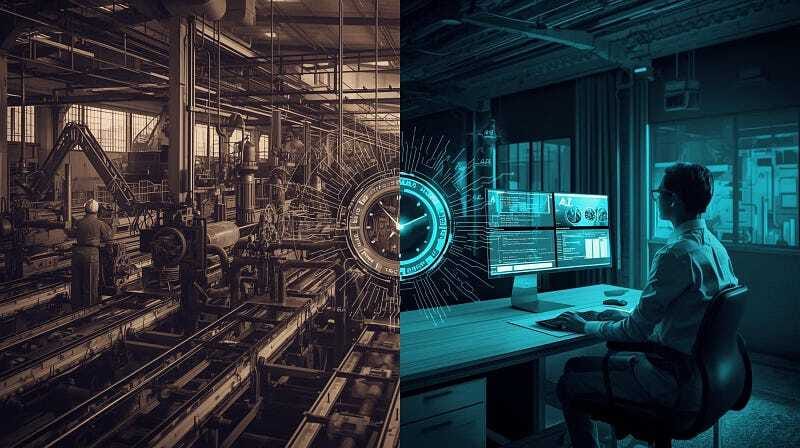 Created by Ross W. Green, MD. Created on October 12, 2025. “Factory to the AI-Powered Office.” Canva.com. | Section 1.2: The Workplace in 2025 – Widespread AI, Mixed Results (due to poor execution) As of 2025, AI has well and truly entered the workplace mainstream. Surveys indicate that nearly 80% of companies report using generative AI in some form, from chatbots to decision-support. It’s on executives’ agendas, and employees across many sectors are experimenting with…read more here.  Created by Ross W. Green, MD. Created on October 12, 2025. “AI Working with Humans” Canva.com. |
Section 2: Key Trends Around Augmentation, New Roles, and Productivity
As AI agents embed themselves deeper into day-to-day business, three major trends are defining how work is changing.
In Section 2.1, “Augmentation Over Replacement,” we explore how most organizations are using AI to elevate, rather than eliminate, human workers, shifting the balance of tasks rather than jobs.
Section 2.2, “Evolving Roles and New Skills,” looks at how emerging positions like prompt engineers and AI operations managers are reshaping team structures and skill requirements.
Finally, Section 2.3, “Productivity Gains and Economic Impact,” examines what the numbers say, including how AI is already boosting output, what returns businesses are seeing, and what this might mean for future growth.
Together, these sections reveal a workforce in transition: augmented, redefined, and steadily adapting to the realities of an AI-powered economy.
Section 2.1: Augmentation Over Replacement (So Far) A key trend is that AI agents in the workplace are mostly being used to augment human workers, not outright replace them…at least for now. The narrative of “AI taking jobs” gets headlines, but many companies report using AI to offload the drudge work and enable employees…read more here.  Created by Ross W. Green, MD. Created on October 12, 2025. “Are Humans or AI in the Driver’s Seat Today?” Canva.com. | Section 2.2: Evolving Roles and New Skills As AI agents take on more routine tasks, the role of the human worker is indeed shifting. We’re seeing the emergence of new hybrid roles: for instance, a marketing professional now might need to be adept at working with content-generating AI (curating its output, crafting the right prompts) in addition to traditional marketing skills…read more here. 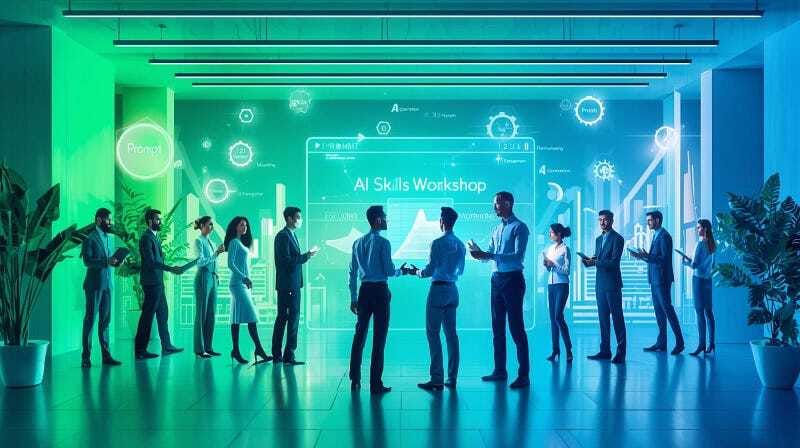 Created by Ross W. Green, MD. Created on October 12, 2025. “New AI Eduction” Canva.com. | Section 2.3: Productivity Gains and Economic Impact The big promise of AI agents at work is to provide a boost in productivity, and early evidence is encouraging. Studies have started quantifying the impact: in a controlled field experiment at a Fortune 500 firm, customer support agents given an AI assistant saw about a 14–15% increase in issues resolved per hour…read more here.  Created by Ross W. Green, MD. Created on October 12, 2025. “Productivity Gains.” Canva.com. |
Section 3: By the numbers
These statistics collectively paint a clear picture: AI adoption is nearly universal, but its full economic potential is still being unlocked. Roughly 80% of companies now use generative AI, yet the same share report limited measurable ROI; this is a clear sign that implementation maturity lags behind enthusiasm. The divide between management (75%) and frontline adoption (51%) underscores this gap in practical integration.
However, where AI agents and systems like agenticOS are deployed effectively, the impact is tangible, including 15% productivity gains, 5% time savings per week, and $3.7 in return per $1 invested. These data points validate that when AI is orchestrated intelligently (as agenticOS aims to do), it shifts from experimental to operational, thereby delivering measurable outcomes rather than just promise.
In short, the numbers highlight both the urgency and the opportunity: widespread use is here, but systems that integrate and manage AI agents effectively will define who actually benefits.
What it Pertains To | Data Point | Source |
Firms using generative AI in some capacity (2024–25) | ~80% of companies (at least pilot use of GenAI) | |
Companies reporting no significant bottom-line AI impact (yet) | ~80% (many have not realized ROI so far) | |
Managers vs. Frontline Workers Regularly Using GenAI | ~75% of managers; only ~51% of frontline staff | |
CX leaders’ view of AI (augmentation vs. replacement) | 75% see AI as a tool to amplify human intelligence, not replace people | https://agentiveaiq.com/blog/how-to-talk-to-smart-customer-service-in-2025 |
Productivity boost with AI assistant (customer support) | 15% more customer issues resolved per hour | |
Work hours saved by employees using GenAI (average) | 5.4% of weekly hours (≈2.2 hours in a 40h week) | |
ROI from generative AI deployments | $3.7 returned per $1 invested (avg); top firms ~$10 per $1 | |
Enterprises using AI agents to enhance operations (by end of 2025) | ~85% (projection based on current trends) |
Section 4: The Future of Work – Collaboration or Competition?
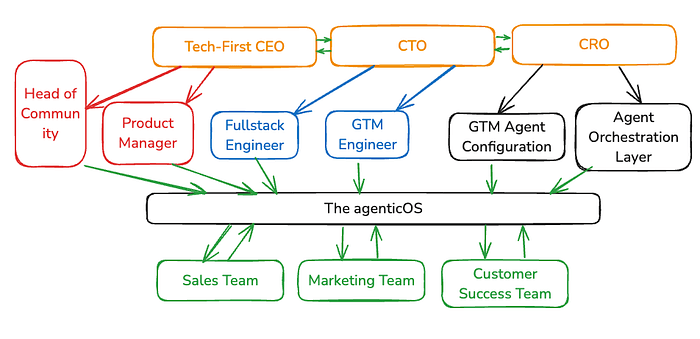
Possible example of hierarchy realignment/leveling as envisioned by Ross W. Green, MD (read on for more here).
Looking ahead, AI agents are set to become even more embedded in every job, which means the nature of work will continue to evolve in profound ways. By 2026, analysts predict the long-term impact on job roles will really start to materialize, and we’ll see some roles significantly transformed and some possibly phased out entirely…read more here.
Final Thoughts:
As AI agents become core contributors to how work gets done, the story of automation enters its most human phase yet.
What began as a march toward efficiency has become a test of adaptability, highlighting our ability to collaborate with machines, redefine roles, and extract value from intelligence that doesn’t sleep or tire. The companies that treat AI as a strategic partner rather than a quick productivity fix will be the ones to thrive, not just by doing more with less, but by unlocking new kinds of output entirely.
The lesson from history is clear: every automation wave reshaped work, but it also expanded what humans were capable of. This transition will be no different…if we manage it wisely.
The line between collaboration and competition is being drawn now; how we cross it will determine whether this era of AI becomes one of disruption or reinvention.
Other resources:
2) Join our Community to access support from peers, a message board, and some great VIP content like our agentAcademy, weekly office hours, etc.
3) Join our weekly webinar series, "The Agentic Future with Devin Kearns" every Friday from noon-1 PM ET (11 AM-noon CT).
4) Follow us on LinkedIn: Ross Green, CAiS, Devin Kearns
5) Want to learn more about how we work (e.g., build-with-you vs. build-for-you; Prebuilt SuperAgents vs, Customized Agents; etc)? Click here to schedule a meeting with us.
6) Have a friend who wants to sign-up for our Newsletter? Click here.
7) Check out Ross Green's Medium Channel
Reply